Plenary "unconference" breakout: 1:00 p.m.-1:45 p.m. [1]With Katherine Fry, Allison Butler, Mellisa Zimdars and Bill Densmore
"Fake news" -- A metaphor for all that ails our media ecosystem?
Lack of facts / alternate facts
A partisan intent to mislead through hoaxes
Comedy, satire masquerading as real
Undisclosed/obfuscated point of view -- an opportunity for media-literacy educators?
THE RESULTS:
A robust, liberating cacaphony of voices -- but who are they and what motivates them?
The decline of trusted "gatekeepers" (See: RJI report)
Do we need a new paradigm for trusted information (See: infotrust.org)
In the last six months, our political discourse has been infected by a new term: “Fake News.” In a 45-minute, circle-round session, we’ll probe the limits of what the term might mean, and how it might be an opportunity to mainstream media-literacy education. We’ll drive toward a consensus statement, addressing such questions as: How do current concepts of “fake” news differ from what was published by 18th-century pamphleteers, or 1960s supermarket tabloids? Is news “fake” based on point of view only, or because it reports as facts things that are demonstrably untrue? Is it only “fake” if its intention is to mislead? Who defines “mislead?” In an age when all of us can be reporters via our Facebook feed, do we all need tutoring on how to create — and consume — trustworthy reporting and information? In social media, is news now anything more than verified gossip? Who is the trusted verifier? Our “conversation catalysts” will start the discussion, then we’ll invite all to to participate.
“It’s the biggest crisis facing our democracy, the failing business model of real journalism,” Senator Claire McCaskill, Democrat of Missouri and a longtime critic of fake news, told me on Saturday. Ms. McCaskill said that “journalism is partly to blame” for being slow to adjust as the internet turned its business model upside down and social media opened the competitive floodgates. “Fake news got way out ahead of them,” she said.
Katherine Fry, a journalism scholar and co-founder of a media literacy organization who teaches graduate media-literacy education at CUNY-Brooklyn
Allison Butler, who runs the media-literacy certificate program and teaches at UMass Amherst
Mellisa Zimdars, assistant professor of communication and media at Merrimack College who is working with a team of librarians and computer programmers to create tools for navigating “news” websites through an OpenSources project called Melissa's List
It’s a huge legal, moral and strategic problem, and it will require . . . “a new social compact” to defuse.
Work on that compact has to start with every school teaching children digital civics. And that begins with teaching them that the internet is an open sewer of untreated, unfiltered information, where they need to bring skepticism and critical thinking to everything they read and basic civic decency to everything they write.
A Stanford Graduate School of Education study published in November found “a dismaying inability by students to reason about information they see on the internet. Students, for example, had a hard time distinguishing advertisements from news articles or identifying where information came from. … One assessment required middle schoolers to explain why they might not trust an article on financial planning that was written by a bank executive and sponsored by a bank. The researchers found that many students did not cite authorship or article sponsorship as key reasons for not believing the article.”
Prof. Sam Wineburg, the lead author of the report, said: “Many people assume that because young people are fluent in social media they are equally perceptive about what they find there. Our work shows the opposite to be true.”
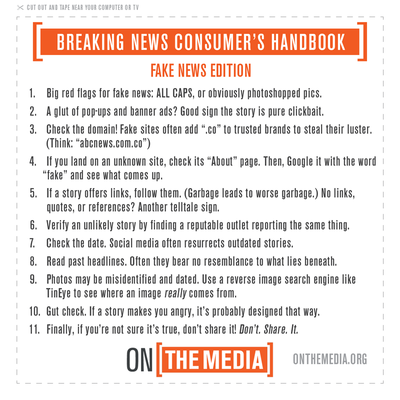


![[1]](https://media2.wnyc.org/i/800/800/l/80/1/OTM_Consumer_Handbook_FakeNewsEdition_800.png)

